
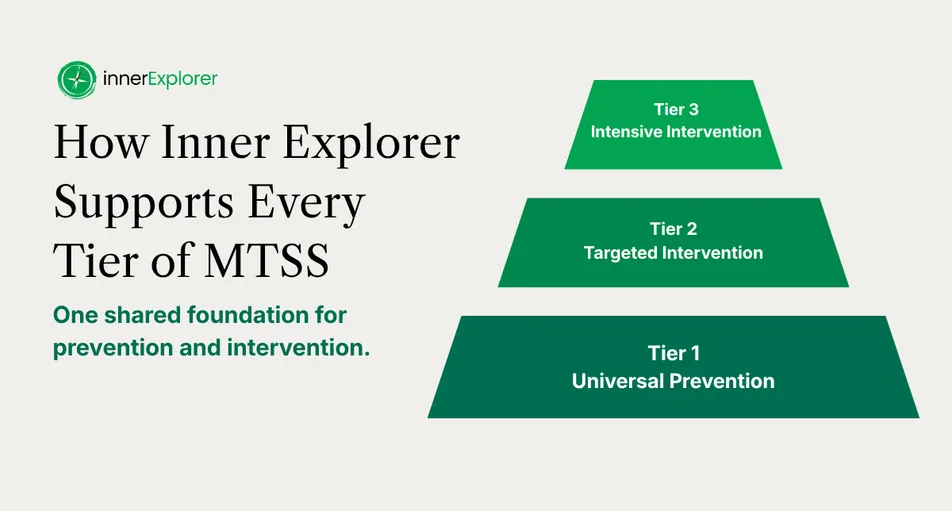
Most district leaders know the MTSS framework inside out. The model is rarely the problem. The problem is the fragmented set of programs running underneath it: a reading intervention here, a behavior tracker there, a separate mental health vendor for students in crisis. Each piece can be valuable on its own. Together they pull staff and students in different directions and create fragmentation in the one place a district needs coherence.
So the question many superintendents are now asking is simple: Is there a single foundation that strengthens every tier of MTSS instead of competing with what is already in place?
For more than 4,000 schools across all 50 states, that foundation is daily mindfulness practice through Inner Explorer.
Why MTSS support becomes a stack of disconnected programs
The fragmentation is not a planning failure. It is built into how most programs are designed. Each one plugs into a single part of the framework: a behavior tool for a handful of students, a small-group curriculum for another slice, a separate vendor for students in crisis. Every tool covers a fraction of the population, so districts keep adding more to reach everyone else.
Over time that produces a familiar result. Narrow, disconnected tools competing for the same budget, the same staff hours, and the same limited attention. A student moving from Tier 1 to Tier 2 to Tier 3 encounters a different program, a different vocabulary, and a different set of expectations at each step, exactly when continuity matters most.
That is why district leaders are right to be wary of the next add-on, and why the real test of any new program is whether it reinforces all three tiers or simply fills one more gap. Very few do. A daily practice that students learn in a Tier 1 classroom, that a counselor can draw on in a Tier 2 group and a Tier 3 plan, is one of the only approaches that works across the whole framework at once, strengthening the structure you already have instead of adding another silo.
Tier 1: a universal foundation every classroom can sustain
Tier 1 is where many universal programs stall. Asking every teacher to deliver a new curriculum on top of academic instruction is rarely sustainable. Inner Explorer works differently. The platform delivers 5 to 10 minute, screen-free audio-guided practices that any educator can play during the school day. No training, no prep, no curriculum change. Teachers press play and practice alongside their students.
“It is not one more thing for teachers to do but a few moments for them to be.”
That simplicity is the strategic advantage. When every classroom can take part at once, mindfulness becomes a shared community practice rather than a specialized intervention. Students build a common vocabulary for self-regulation, and teachers and families can practice the same skills at home, which reduces stigma and reinforces the routine.
The outcomes at this universal level are substantial. Across partner schools, daily practice is associated with:
- 77% Fewer school-wide discipline events, Kaiser Elementary
- 85% Fewer behavior issues in special education classrooms, La Joya ISD
These are universal-level results from a practice every student receives, achieved without a single targeted referral. For most schools, this is the tier that does the heavy lifting: roughly 80 percent of students have their needs met through strong universal support alone.
Tier 2: reinforcing the same skills in small groups
When students need more than universal support can offer, Tier 2 provides targeted reinforcement, usually in small groups. The challenge most districts hit is continuity. If the small-group work runs on a different framework than the classroom, students have to translate between systems at the exact moment they are already struggling to cope.
Inner Explorer’s Support Staff Series keeps the foundation consistent. Counselors and intervention specialists use targeted practices for focus, anxiety, anger, or peer conflict that build directly on the self-regulation skills students already know from their classrooms. The vocabulary is shared and the techniques are familiar, so moving into Tier 2 feels like deepening a practice rather than starting over.
For district leaders, that continuity has a quiet operational payoff. Staff across tiers are aligned in their approach, and data trends become easier to compare because the underlying theory and practice are the same.
Tier 3: intensive support built on a familiar foundation
Tier 3 serves students with the most intensive needs, including those facing significant trauma, mental health challenges, or behavioral disorders. Inner Explorer is not a clinical replacement for individualized therapy or specialized care. What it offers is a regulation tool that counselors, social workers, and outside clinicians can layer into individualized plans, on top of a skill the student already practices every day.
What a coherent MTSS foundation means for district leaders
For superintendents and administrators weighing how to align tiered supports, three things tend to matter most.
Coherence lowers cost and operational burden
One foundational practice that strengthens all three tiers reduces the need to stack interventions that overlap, conflict, or compete for staff time. At scale it runs at less than $8 per student per year, and some districts are now replacing expensive, screen-based programs with this single affordable, screen-free practice that supports every tier.
There is an operational payoff, too. When Tier 1 is strong, fewer students escalate into Tier 2 and Tier 3, which matters when counselors are stretched thin and shrinking budgets make new hires hard. A universal practice that meets most students’ needs lets counselors spend their limited hours on the students with the greatest needs.
The evidence base is unusually deep for a universal mindfulness program
Inner Explorer is built on the Mindfulness-Based Stress Reduction protocol, which connects it to more than 16,000 studies on mindful awareness collected over four decades. The program itself has been examined in six peer-reviewed and university studies, two meta-analyses, and BrainFutures lists it among the top 10 programs in education for improving executive function.
Universal access reaches every student
Because the practice is universal and daily, it reaches every child in the building, not only those whose families can get to outside services. That matters most for the students who are least likely to opt into a separate program yet stand to benefit the most. A single Tier 1 foundation supports them by default, rather than waiting on a referral.
A foundation, not another program
The strongest case for Inner Explorer at the district level is not what it adds to your MTSS framework. It is what it makes possible across the framework you already have: a shared vocabulary at Tier 1, continuity into Tier 2 groups, and a regulation foundation that strengthens Tier 3 work, with less burden on educators and measurable movement in behavior, attendance, academics, and staff wellbeing.
Superintendents who are tired of stitching together disconnected programs often find that the alignment they have been looking for starts with one daily practice every tier can build on. The next step is simply to see it in your own schools.