
When we talk about enhancing athletic performance we tend to talk about the physical. Endurance, strength, speed, flexibility, and so on. What seems to get pushed to the side is one of the body’s most trainable assets, the brain. The brain responds to training the same way a muscle does, building cognitive networks, strength, and resilience with daily, deliberate practice. Mental resilience, the ability to stay focused, manage stress, and reset after failure, may be the most important skill in athletics. It is the work that the most successful athletes credit when they talk about performing under pressure.
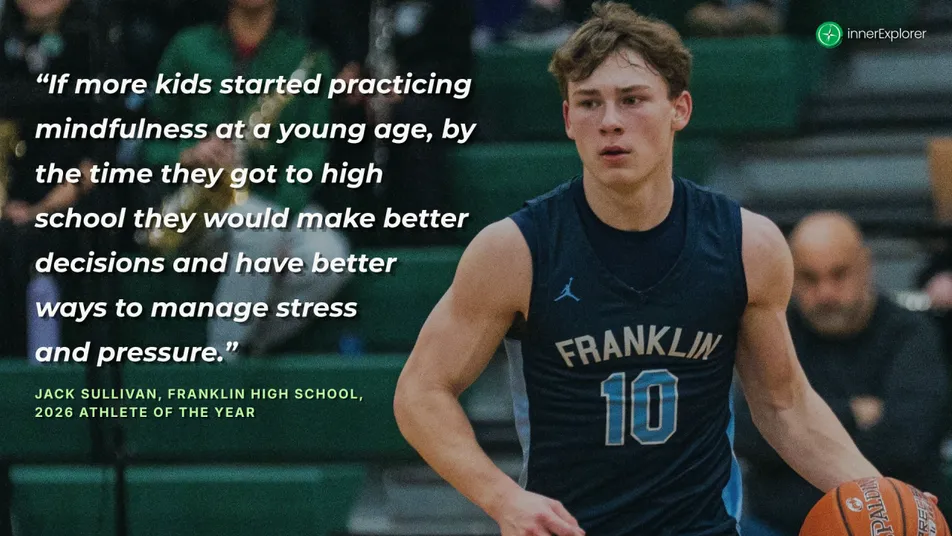
Jack Sullivan, senior captain of the baseball and basketball teams at Franklin High School in Massachusetts, was just awarded Athlete of the Year. If you were to ask him what he credits for his success, he would tell you it is daily mindfulness practice and the mental resilience it builds. He did not stop at improving his own performance. He introduced the daily 5 minute mindfulness practice to his varsity baseball team, and the results, in his teammates’ own words, have been a difference they can feel both on the field and in the classroom.
Athletes are some of the most stressed students in our schools
Roughly 91 percent of high school athletes report experiencing stress related to their sport, and 58 percent describe that stress as moderate to extreme. Anxiety and depression among student-athletes have been steadily rising for more than a decade. And even at the college level, only about 1 in 10 athletes facing mental health challenges actually ask for help.
These young people are juggling academic pressure, recruiting timelines, social demands, and the very public ups and downs of competition. Add in the basic biology that a brain in fight or flight cannot focus on the lesson or the play in front of it. Daily mindful awareness is what helps the brain settle back into a state where focus, decision making, and emotional regulation are possible.
The pros have been doing this for decades
Since taking an active interest in mindfulness, Rory McIlroy has found a new level of consistency and winning every men’s professional major championship over the course of his career. Being one of only 6 male golfers in history to achieve this feat. He also won the Masters this year and last, something only a few golfers have ever done. He explains it simply: “I’m almost making more time to practice my mind-set rather than to be on the range.”
LeBron James uses guided meditation, deep breathing, and closed-eye visualization to center himself before and during games. “What is a strong body without a sound mind? We’re so focused on strength that we forget the strength of our focus. The mind is like a muscle. The more you train it, the stronger it becomes. While greats master the body, the greatest master the mind.”
Kobe Bryant called his morning practice an anchor for his entire day: “If I don’t do it, it feels like I’m constantly chasing the day, as opposed to being controlled and dictating the day.”
Mental fitness is not the soft part of the game. It is the part of the game that separates good from great, and increasingly, it is the part that pro athletes credit when they talk about longevity, leadership, and clutch performance.
What Jack noticed, and what his team is now seeing
In the fall and winter of his senior year, Jack started leaning on Inner Explorer’s audio-guided practices during the basketball season. He was the captain of a returning Division 1 state championship team, and he felt the pressure. In his own words, he was genuinely stressed and anxious before some games.
So he tried something different. He began doing a 5 minute mindfulness practice on the bus rides to each game. He noticed his stress quieted. He felt calmer when he stepped onto the court. He played his best basketball in the games where he had taken those five minutes for himself.
When baseball season arrived, Jack opened the practice up to his teammates. There was no requirement, just an open invitation from their captain. Some leaned on it before practices and games. Others used it on their own when they needed to reset.
The feedback from his teammates follows:
- 100 percent of teammates surveyed said they found the practices helpful
- Players reported feeling calmer and less stressed about school, sports, and other commitments
- Teammates described feeling more centered and ready before practices and games
- Many shared they felt more present and “in the moment” once they stepped onto the field
Several teammates added that they wished a tool like this had been available to them years earlier. That insight sits at the heart of why Inner Explorer exists, and Jack said it best:
If more kids started practicing mindfulness at a young age, by the time they got to high school they would make better decisions and have better ways to manage stress and pressure.
The science behind mindfulness and what his team is feeling
Mindful awareness has been studied for more than 40 years, with over 14,000 peer-reviewed scientific articles documenting its effects on attention, emotion regulation, and stress response. Inner Explorer’s daily practices were developed alongside experts in neuroscience, psychology, and education, and have been associated with a 15 to 28 percent improvement in academic performance, a 60 percent reduction in behavioral incidents, and a 43 percent reduction in teacher stress.
At Inner Explorer, we call this biology before behavior. Before a student or athlete can focus, regulate emotion, or make a clear decision, their nervous system has to come out of fight or flight. When the nervous system is dysregulated, no amount of mental effort can override it. The body has to settle before the mind can do its work. Daily mindful awareness gives the brain and body a repeatable way to do that. Heart rate slows, the breath deepens, the prefrontal cortex comes back online, and only then can focus, coachability, and good decision making actually take hold.
It is also one of the very few stress-management tools that does not involve a screen. When most students feel overwhelmed today, they reach for their phones, and the research is consistent that more screen time tends to amplify anxiety rather than ease it. Inner Explorer offers the opposite. Five quiet minutes with eyes closed and nothing competing for the brain’s attention. For a generation of student-athletes who are rarely unplugged, that contrast alone is part of why the practice lands.
For athletes specifically, an NCAA Division I study of 25 players found that a structured mindfulness training program decreased stress and improved resilience, coping skills, and focus. That is exactly the skill set baseball demands. As Jack reminded his teammates, baseball is a game of failure where the best hitters in the world succeed only about 30 percent of the time. Without mental tools, that kind of failure rate gets in your head fast. With them, it becomes the next at-bat.
What Franklin’s varsity team took from the 2026 season: clearer minds and calmer nervous systems
As Franklin’s baseball season comes to an end, these athletes, thanks to Jack, can walk away with a shared daily practice that helps them reset, refocus, and manage the very real pressure of being not just a student-athlete but a human in today’s society.
This is what mental wellness looks like at the high school level when a student-athlete decides to lead with it. It does not require new equipment, additional practice time, or a sports psychology budget. It requires five quiet minutes, a willingness to try something new, and a leader who can model it.
To every coach, athletic director, and parent of a student-athlete reading this, the invitation is simple. Practicing daily mindfulness is to mental health what brushing your teeth is to dental health. Five minutes a day, every day, changes what athletes can carry, how clearly they can think, and how present they can be when it matters most.
Thank you, Jack for leading by example, and for showing your teammates and your community what it looks like to take care of the whole athlete. Go Franklin!
If you’re interested in bringing daily mindfulness to your team, athletic department, or school community, contact us here: Contact Us at Inner Explorer
Read more about Inner Explorer’s daily mindfulness program here: https://innerexplorer.com/
Sources
- Prevalence of stress amongst high school athletes (PMC)
- Prevalence of stress amongst high school athletes (Health Psychology Research)
- Anxiety and Depression Prevalence in Incoming Division I Collegiate Athletes From 2017 to 2021 (PMC)
- Mental health challenges and substance use in student-athletes (Frontiers)
- Tackling Mental Health with High School Student-Athletes (Uwill)